Bend Guidance Configuration
Bend radius thresholds are specified in the rows of the lookup table tblDTCBendRadiusLimits. In starting point Digital Factories, the table has a single row which applies to any material type:
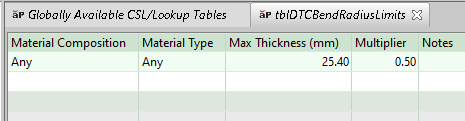
Digital Factory administrators can add rows that apply to specific material types or specific material compositions. (To add a row to a lookup table, right click the table’s name in the navigation pane of the Digital Factory Manager, and select Add Lookup Table Entry….)
The Multiplier column of each row contains the threshold (as a multiplier of blank thickness) for blanks with a specified material composition or material type and with a thickness within a specified range.
The table has the following columns:
• Material Composition: specifies the material composition to which the row applies. A row in tblDTCBendRadiusLimits applies to those materials whose Name property matches or contains the value of the row’s Material Composition column. If the Material Composition column contains Any, the row applies to the materials of the type specified by the Material Type column—see below. If both the Material Composition and Material Type column contain Any, the row applies to all materials.
• Material Type: specifies the material type to which the row applies, provided that the row’s Material Composition column contains Any. Such a row applies to those materials whose Material Type property matches the value in the row’s Material Type column. If both the Material Composition and Material Type columns contain Any, the row applies to all materials.
• Max Thickness: specifies the ceiling of the thickness range to which the row applies. A row applies to a given thickness if the row’s Max Thickness is the smallest Max Thickness listed in tblDTCBendRadiusLimits that is greater than or equal to the given thickness.
• Multiplier: specifies, as a multiplier of blank thickness, the threshold for blanks with material and thickness to which the row applies.
If a blank’s thickness is greater than all Max Thickness values listed in tblDTCBendRadiusLimits, the largest Multiplier in tblDTCBendRadiusLimits specifies the threshold for the blank, regardless of the blank’s material.
Other thresholds related to bends are specified by the rows of the lookup table tblDTCBendGuidance (except hole-to-bend proximity thresholds—see Hole Proximity Guidance Configuration):
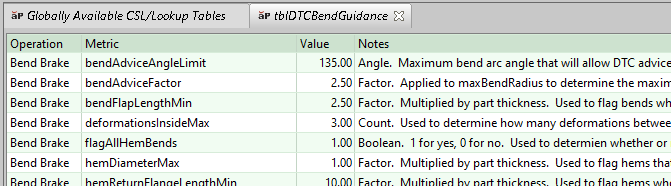
The Value column of each row contains a specified type of threshold for a specified type of operation. For example, the first row in the table above specifies the maximum bend arc angle that triggers DTC advice if feasibility fails.
The table has the following columns:
• Operation: specifies a category of processes and/or operations to which the row applies. For example, the first row in the table above specifies a threshold for the Bend Brake process. The lookup table tblDTCOperationNameReference lists the specific processes and operations that fall into a given category. Rows with None in the Operation column apply to operations not specified elsewhere in the table.
• Metric: specifies the threshold type. Each threshold type is described in the Notes column.
• Value: specifies the threshold, which can be of one of the following types:
o angle: in degrees
o length: in millimeters
o factor: multiple of blank thickness
o count: the number of deformations that bear a specified relation to the main surface
o Boolean: true or false
The Notes column specifies the value type.