Nominal Wall Thickness
Nominal wall thickness is an important determinant of cooling time—see Times for Plastic Molding. It can also affect required clamp force and therefore machine selection—see Required Clamp Force.
Nominal wall thickness is calculated by default, but can be specified by the user—see User Inputs for Plastic Molding. aPriori uses a number of different formulas for the calculation of nominal wall thickness. Which formula it uses depends primarily on how much variation there is in the part’s wall thickness. It also depends on the part’s aspect ratio.
• High variation: For parts with a high amount of variation in thickness, the nominal wall thickness is the largest part thickness excluding thickness values from the thickest 20% of the part’s surface area.
Variation in thickness is measured by the size of the standard deviation from the mean thickness—the larger the standard deviation, the greater the variation in thickness. A part is considered to have a high amount of thickness variation if the geometric property Thickness Std Dev is greater than the value of the cost model variable medThicknessDevThreshold (0.50mm in starting point Digital Factories).
The largest part thickness excluding thickness values from the thickest 20% of the part’s surface area is given by the following geometric property:
Min 80 Thickness
• Non-high variation and high aspect ratio: For parts that don’t have a high amount of variation in thickness and have a high aspect ratio, the nominal wall thickness is the largest part thickness excluding thickness values that lie beyond four standard deviations from the mean thickness (that is, excluding the highest 0.1% of thickness values, assuming a normal distribution of values).
A part is considered to have a high aspect ratio if Height / Length is greater than or equal to the value of the cost model variable highAspectRatioThreshold (0.50 in starting point Digital Factories). (Recall that the Height direction is the draw direction, for plastic molding process groups.)
The largest part thickness excluding thickness values that lie beyond four standard deviations from the mean thickness depends on the geometric properties Avg Thickness and Thickness Std Dev. It is:
Avg Thickness + 4 * Thickness Std Dev
• Non-high aspect ratio and low variation: For parts that don’t have a high aspect ratio and have a low amount of thickness variation, the nominal wall thickness is the largest part thickness excluding thickness values that lie beyond three standard deviations from the mean (that is, excluding the highest 0.3% of thickness values, assuming a normal distribution).
A part is considered to have a low amount of thickness variation if the geometric property Thickness Std Dev is less than or equal to the value of the cost model variable lowThicknessDevThreshold (0.30mm in starting point Digital Factories).
The largest part thickness excluding thickness values that lie beyond three standard deviations from the mean depends on the geometric properties Avg Thickness and Thickness Std Dev. It is:
Avg Thickness + 3 * Thickness Std Dev
• Non-high aspect ratio and medium variation: For parts that don’t have a high aspect ratio and have a medium amount of thickness variation, the nominal wall thickness is the average of the following values:
o Largest part thickness excluding thickness values from the thickest 20% of the part’s surface area
o Largest part thickness excluding thickness values that lie beyond three standard deviations from the mean (that is, excluding the highest 0.3% of thickness values, assuming a normal distribution)
A part is considered to have a medium amount of thickness variation if the geometric property Thickness Std Dev is greater than the value of the cost model variable lowThicknessDevThreshold (0.30mm in starting point Digital Factories) and less than or equal to the value of the cost model variable medThicknessDevThreshold (0.50mm in starting point Digital Factories).
The information above is summarized in the following table:
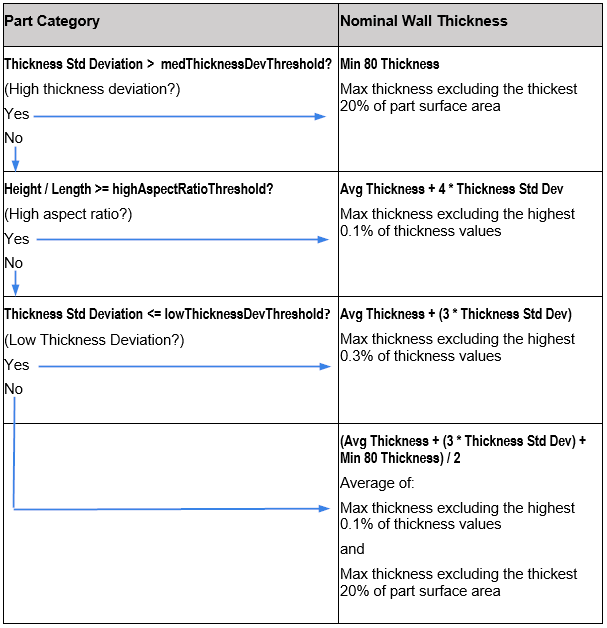
Note that some of the percentages in the table assume a normal distribution for the part’s thickness values.
Note: If the calculated value for nominal wall thickness exceeds the maximum thickness value observed on the part (due to CAD modeling errors or due to sampling/ray tracing errors in aPriori), nominal wall thickness is set to the maximum thickness value.
The custom output Nominal Wall Thickness Profile indicates how the part is categorized. This output is displayed in the Part Details tab when you use the Manufacturing Details table view.
Note: A part’s Nominal Wall Thickness Profile is High aspect ratio if and only if it has a high aspect ratio and low or medium thickness variation. Otherwise, the Nominal Wall Thickness Profile is High thickness deviation, Medium thickness deviation, or Low thickness deviation.