Hole proximity thresholds are specified by the rows of the lookup table tblDTCHoleGuidance:
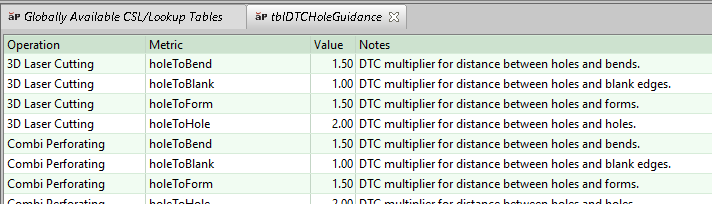
The Value column of each row contains the threshold (as a multiplier of blank thickness) for proximity to a specified type of feature, for a specified a specified type of operation. For example, the first row in the table above indicates that the hole-to-bend proximity threshold for the hole cutting operations of the 3D Laser Cutting process is 1.50 times the blank thickness.
The table has the following columns:
-
Operation: specifies a category of processes and/or operations to which the row applies. For example, the first row in the table shown above specifies a threshold for the hole cutting operations of the 3D Laser process. The lookup table tblDTCOperationNameReference lists the specific processes and operations that fall into a given category. For example, for the category Combi Punch (which can appear in the Operation column of tblDTCHoleGuidance), tblDTCOperationNameReference lists all the hole nibbling and hole punching operations of the Plasma Punch and Laser Punch processes. Rows with Other in the Operation column apply to operations not specified elsewhere in the table.
-
Metric: specifies the feature to which the row applies. For example, the first row in the table shown above specifies the threshold for the proximity of a hole to a bend. Possible values for Metric include:
Column
Description
holeToBend
Proximity of a hole to a bend.
holeToBlank
Proximity of a hole to a blank edge.
holeToForm
Proximity of a hole to a form.
holeToHole
Proximity of a hole to another hole.
largerHoleToBend
Proximity of a larger hole to a bend, where a hole is considered large if its diameter is greater than or equal to the threshold defined by largerHoleToBendThreshold; see below.
largerHoleToBlank
Proximity of a larger hole to a blank edge, where a hole is considered too large if its diameter is greater than or equal to the threshold defined by largerHoleToBlankThreshold; see below.
largerHoleToForm
Proximity of a larger hole to a form, where a hole is considered large if its diameter is greater than or equal to the threshold defined by largerHoleToFormThreshold; see below.
largerHoleToHole
Proximity of a larger hole to another hole, where a hole is considered large if its diameter is greater than or equal to the threshold defined by largerHoleToBlankThreshold; see below.
largerHoleToBendThreshold
For the purpose of evaluating hole-to-bend proximity, a hole is considered large for a given operation type if its diameter is greater than or equal to the threshold defined by largerHoleToBendThreshold for the given operation type.
The threshold defined by largerHoleToBendThreshold, for a given operation type, is the product of the following: (1) the blank thickness and (2) the Value for the row of tblDTCHoleGuidance whose Operation is the given operation type and whose Metric is largerHoleToBendThreshold.
largerHoleToBlankThreshold
For the purpose of evaluating hole-to-blank proximity, a hole is considered large for a given operation type if its diameter is greater than or equal to the threshold defined by largerHoleToBlankThreshold for the given operation type.
The threshold defined by largerHoleToBlankThreshold, for a given operation type, is the product of the following: (1) the blank thickness and (2) the Value for the row of tblDTCHoleGuidance whose Operation is the given operation type and whose Metric is largerHoleToBlankThreshold.
largerHoleToFormThreshold
For the purpose of evaluating hole-to-form proximity, a hole is considered large for a given operation type if its diameter is greater than or equal to the threshold defined by largerHoleToFormThreshold for the given operation type.
The threshold defined by largerHoleToFormThreshold, for a given operation type, is the product of the following: (1) the blank thickness and (2) the Value for the row of tblDTCHoleGuidance whose Operation is the given operation type and whose Metric is largerHoleToFormThreshold.
largerHoleToHoleThreshold
For the purpose of evaluating hole-to-hole proximity, a hole is considered large for a given operation type if its diameter is greater than or equal to the threshold defined by largerHoleToHoleThreshold for the given operation type.
The threshold defined by largerHoleToHolehreshold, for a given operation type, is the product of the following: (1) the blank thickness and (2) the Value for the row of tblDTCHoleGuidance whose Operation is the given operation type and whose Metric is largerHoleToHoleThreshold.
smallerHoleToBend
Proximity of a smaller hole to a bend, where a hole is considered small if its diameter is less than the threshold defined by largerHoleToBendThreshold; see above.
smallerHoleToBlank
Proximity of a smaller hole to a blank, where a hole is considered small if its diameter is less than the threshold defined by largerHoleToBlankThreshold; see above.
smallerHoleToForm
Proximity of a smaller hole to a form, where a hole is considered small if its diameter is less than the threshold defined by largerHoleToFormThreshold; see above.
smallerHoleToHole
Proximity of a smaller hole to another hole, where a hole is considered small if its diameter is less than the threshold defined by largerHoleToHoleThreshold; see above.
uniqueHoleSizesMax
Specifies how many unique hole sizes are allowed (the default is 1 in starting point Digital Factories).
-
Value: specifies the threshold as a multiple of blank thickness. For example, the first row in the table shown above indicates that the hole-to-bend proximity threshold for the hole cutting operations of the Laser Cutting process is 1.50 times the blank thickness.