Each Sand Casting routing consists of all the following processes:
Melting
Molding and Coring process routing
Shakeout
Degating (optional; see below)
Cleaning
Finishing
Visual Inspection
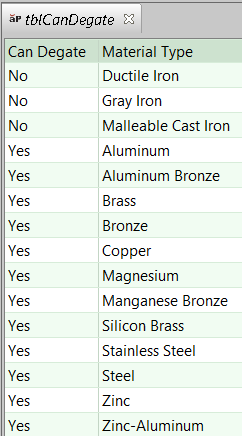
Degating is included in the routing unbless the part material is listed with No for Can Degate in the lookup table tblCanDegate.
The Molding and Coring routing has a variety of alternative sub-routings, which are shown in the diagrams below.


See Sand Casting General Process and Sand Casting Process-level Feasibility for more information on mold-making processes.
The core-making routings that are shown in the diagram above each have 0 or more occurrences of each of the processes shown below.

See Coremaking Feasibility and Routing for Sand Casting for more information.
By default in starting point Digital Factories, refractory coating and drying are assumed to be applied to any cores, as well as to any molds created by manual moldmaking. (Refractory coating is also known as "foundry coating", "protective coating", "wash", and "blacking".) There can be multiple instances of a mold or core coating process in order to model the application of multiple coats. See Refractory Coat Mold and Refractory Coat Cores for Sand Casting for more information.

Cores and molds are oven dried by default, if they can fit in an oven; otherwise they are air dried. There can be multiple instances of a drying process in order to model drying after each of multiple coats. See Refractory Coat Oven Dry for Sand Casting and Refractory Coat Air Dry for Sand Casting.

Users can also manually include refractory coating and drying of molds that are created by automatic molding. In addition, users can manually include air drying instead of oven drying. See Refractory Coating Setup Options for Sand Casting for more information.
If you have licensed the Machining process group, your routing can include any of the following secondary processes:
3-Axis Milling
Cylindrical Grinding
Gun Drill
2-axis Wire EDM operations
Single Index Milling and Rotor Grinding operations (if helical groove geometry is present)
If you have licensed the optional Turning module, your routing can include the turning processes using the following lathe types:
2-axis
3-axis,
4-axis
6-axis
If you select This part may be machined in the Production Scenario tab of the Cost Guide, machining is automatically included in your routing when casting cannot achieve the required tolerances or some features do not meet manufacturability requirements.
Note: If you select This part is not machined in the Production Scenario tab of the Cost Guide, but then manually select any GCD operation sequences which require machining, the corresponding GCDs will fail to cost with the message User-selected operations are unavailable in the current routing.
Your routing can also include processes from the following process groups, if you have licensed these modules: