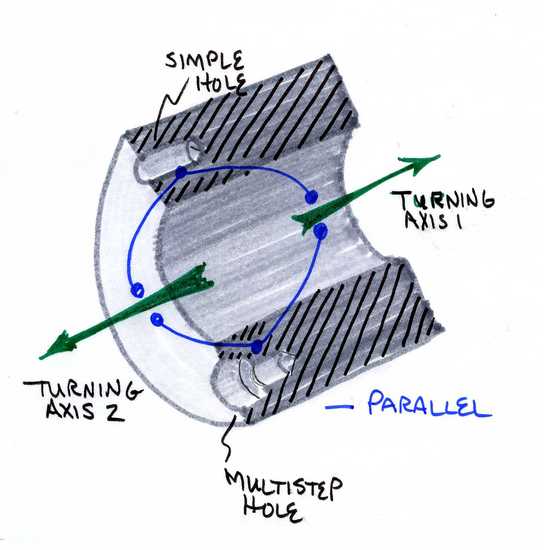
The GCD Relations Category indicates relations between GCDs. It includes the following GCD relation types:
GCD Relations are visible in the Geometric Cost Drivers pane. The image below shows the GCD Relations involving the GCDs that comprise Ring:1.
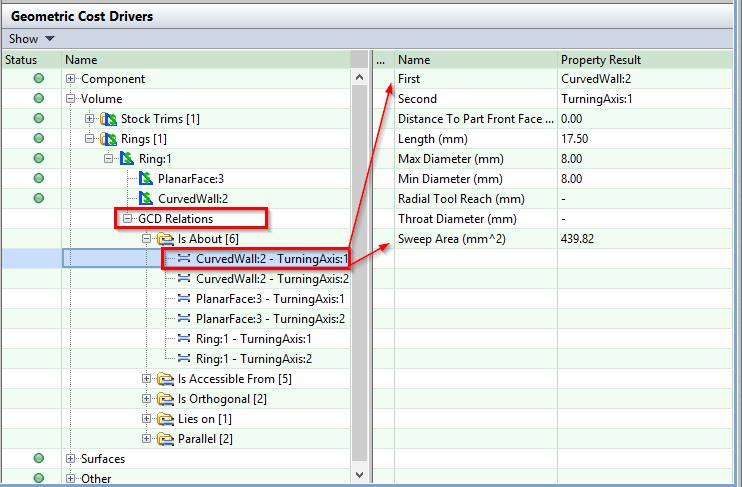
See GCD Relations in the Cost Model Guide for more details. The process group chapters of the Cost Model Guide also contain process-group-specific information on these relations.
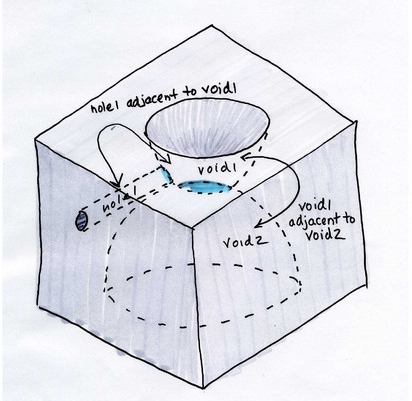
Adjacent
Exists When: Surfaces share one or more common edges or edges share one or two common vertices. Used, for example, to help identify the primary form in Transfer Die.
-
Symmetric: Yes.
-
Transitive: No.
Coaxial
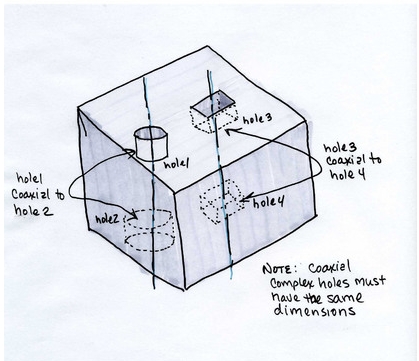
Exists When: When one GCD and another one share the same axis. Used, for example, to identify part setups for Machining.
-
Symmetric: Yes
-
Transitive: No
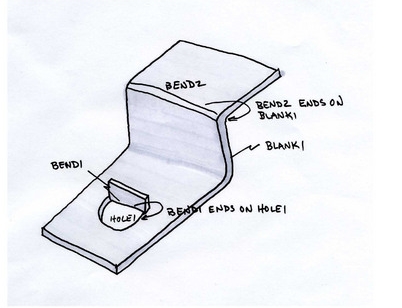
Ends On
Exists When: the end edge of the first GCD lies on the contour of the second GCD. Used, for example, to evaluate operation feasibility in Sheet Metal.
-
Symmetric: No
-
Transitive: No
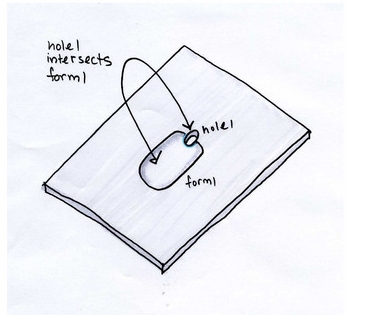
Intersects
Exists When: A portion of the two GCD boundaries are coincident or touching at one or more points, or when the boundary of one lies inside of the boundary of another. Used, for example, to evaluate operation feasibility in Sheet Metal.
-
Symmetric: Yes
-
Transitive: No
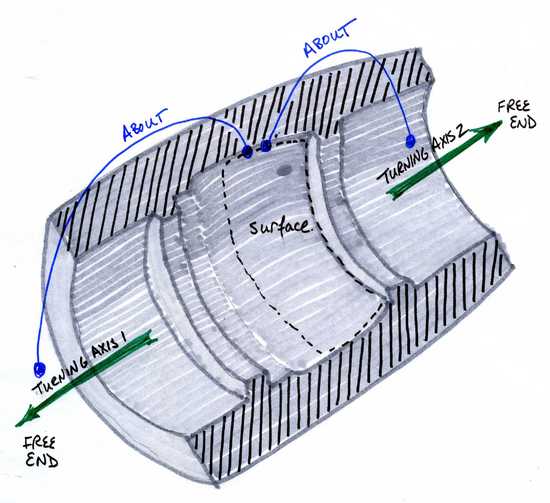
Is About
Exists When: GCD is about a turning axis. Used, for example, to evaluate operation feasibility in Machining.
-
Symmetric: No
-
Transitive: No
Is Accessible From
Exists When: A GCD is accessible from (or not obscured from) the provided SetupAxis. Used, for example, to identify part setups for Machining.
-
Symmetric: No
-
Transitive: No
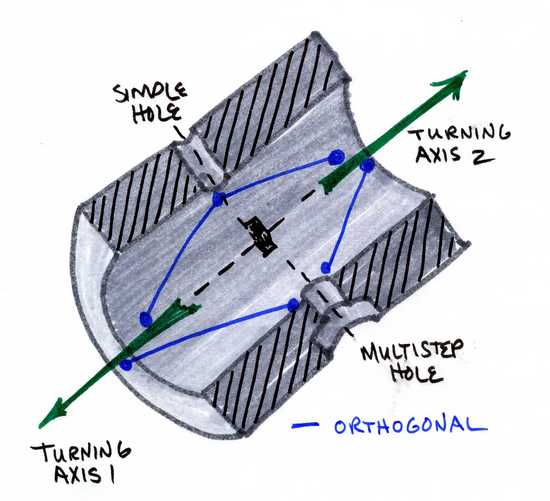
Is Orthogonal
Used, for example, to evaluate operation feasibility in Machining.
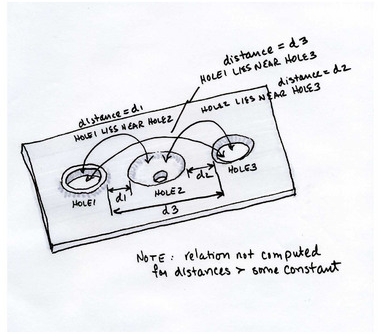
Lies Near
Exists When: The distance between the two GCD is less than the recognition distance defined for the combination of GCD types and their attribute values. Used, for example, to identify primary forms for Hydroforming.
-
Symmetric: Yes
-
Transitive: No
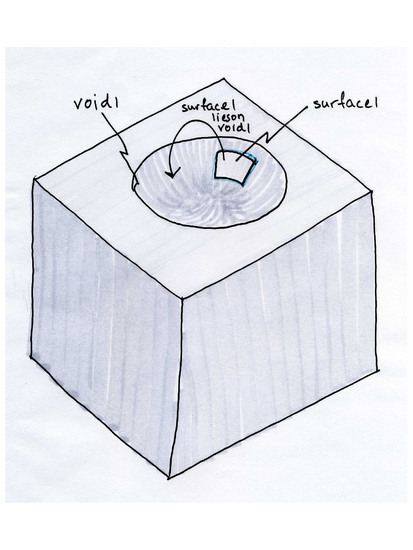
Lies On
Exists When: One GCD lies on another one. Used, for example, to evaluate operation feasibility in Sheet Metal.
-
Memo: A LIES_ON relation is created between: - Forms with subType == GUSSET and StraightBend GCDs - When 1st Form is of subType == SIDE_ACTION.
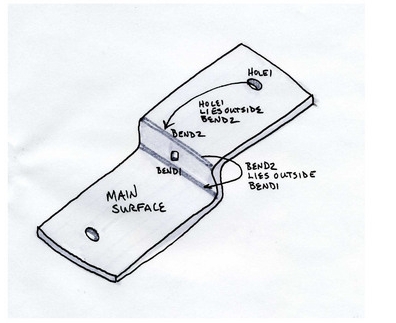
Lies Outside
Exists When: The main surface is defined and GCD1 lies in the same bend step path as GCD2 and there are less 'steps' along the path to get to any blank edge in increasing distance for GCD1 than for GCD2. Used, for example, to evaluate operation feasibility in Sheet Metal.
Parallel
For Sheet Metal:
-
Between Straight Bends: it does not at all mean that the bends are geometrically parallel - only that they end at the same GCDs.
-
Between base and corresponding offset FaceFinishArtifacts (Planar Face, Curved Wall, and Curved Surface).
For Turning: Parallel relation between a planar face and a turning axis is created when the plane is parallel to the axis.