Processes
The Investment Casting cost model uses the following processes:
• Cooling
• Cleaning
Core Molding
Core Molding models the use of injection molding to create any required cores that will be used in the creation of the wax patterns. There are two alternative core molding processes:
• Soluble Wax Core Making: aPriori groups together undercut artifacts that are expected to be handled by a single core. These artifacts are children of a CoreBundle GCD. If all the artifacts in a CoreBundle have an aspect ratio that is large enough to allow refractory material to properly drain during shell making, the corresponding core is assumed to be made of soluble wax. This core is used during Wax Pattern Molding, and then is dissolved during Soluble Wax Leaching before Shell Making is performed.
• Ceramic Core Making: if any artifact in a CoreBundle has an aspect ratio that is too small to allow refractory material to properly drain during shell making, the corresponding core is assumed to be ceramic. After the core is molded, it rests (modeled by Ceramic Core Resting--a component-level operation of the Bench Operation process) before it is fired with Ceramic Core Firing. Finally, it is finished with Ceramic Core Finishing (a component-level operation of the Bench Operation process). The core is used during Wax Pattern Molding, and then remains in the pattern during shell making. It is dissolved during Ceramic Leaching, after Metal Pouring, Cooling, Shakeout, and Cutoff.
The core molding processes account for labor, overhead, and hard tooling costs associated with making the cores.
For more information, see the following sections:
Wax Pattern Molding
Wax Pattern Molding models the use of injection molding to create wax patterns, which will later be assembled into trees, and then dipped in refractory material to create the shell molds. This process accounts for labor, overhead, and hard tooling costs associated with making the wax patterns. The cycle time calculation accounts for various activities, including the following:
• Manual assembly and disassembly of the mold
• Opening and closing of the mold
• Manual insertion of any cores and chill into mold
• Injection of wax into the mold
• Cooling of the wax pattern
• Manual removal of the wax pattern from mold
For more information, see the following sections:
Soluble Wax Leaching
For parts that use soluble wax cores, the finished wax pattern is placed in a bath that dissolves the cores prior to shell making. This process accounts for the associated labor and overhead costs. Cycle time is based on the total mass of the dissolved core. Machine selection is based on the box dimensions of the wax pattern.
For more information, see the following sections:
Pattern Finishing
Pattern Finishing is a component-level operation of the Bench Operation process. The process models the manual removal of the parting line and surface blemishes from the wax pattern. Cycle time is based on pattern surface area and includes a flat amount of time for visual inspection.
For more information, see Pattern Finishing Formulas.
Pattern Sub-Assembly
Complex wax patterns sometimes consist of multiple sub-components that must be assembled after pattern molding and finishing. By default in starting point Digital Factories, the cost model assumes that no such assembly is required. But Administrators or end users can indicate a number of pattern components greater than 1 (via cost model variable or setup option), in which case the cost model accounts for assembly time and costs based on the required number of joints. This is a component-level operation of the Bench Operation process.
For more information, see the following sections:
Tree Assembly
Tree Assembly models the assembly of a tree out of one or more wax patterns, runners, gates, wax vents, and a pour cup. Shell molds will later be made by dipping the tree in refractory material. There two types of trees:
• Carousel trees (the default in starting point Digital Factories: wax patterns are arranged around a central, vertical runner.
• Panel trees: wax patterns are arranged in columns and rows.
The process accounts for labor and overhead associated with tree assembly. Cycle time is based on the following:
• Number of wax patterns in tree
• Number of runners in tree
• Number of gates per wax pattern
• Number of wax vents
The number of wax patterns per tree is determined, by default, based on the following:
• Orientation of the wax pattern relative to the tree (which can be specified with a setup option)
• Number of layers of patterns per tree that can be accommodated by the available slurry dip tank used for Shell Making, given the pattern orientation and spacing allowances
• Number of patterns per tree layer that can be accommodated by the available slurry dip tank, given the pattern orientation and spacing allowances
Number of layers per tree and number of patterns per layers can also be specified with setup options.
Tree Assembly is a component-level operation of the Bench Operation process.
For more information, see the following sections:
Shell Making
Shell making models repeatedly dipping a tree in a ceramic slurry bath and then coating it with sand particles in order to build up a multi-layer shell that is used as the mold for the final part. This activity is modeled by the following nodes in the Manufacturing Process Pane:
• Multiple Face Coat Cycle nodes
• Multiple Backup Coat Cycle nodes
• Drying
• Robotic Assist
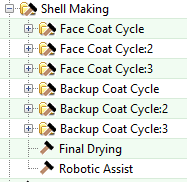
Each Face Coat Cycle consists of the following processes:
• Primary Slurry Dipping
• Primary Sand Coating
• Drying (air dry)
Each Backup Coat Cycle consists of the following processes:
• Secondary Slurry Dipping (uses more viscous material, compared to Primary Slurry Dipping)
• Secondary Sand Coating (uses coarser sand, compared to Primary Sand Coating)
• Drying (air dry)
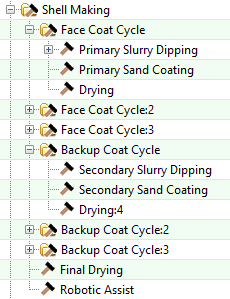
The total number of shell layers is the sum of the number of Face Coat cycles and the number of Backup Coat cycles. The number of shell layers is based on part weight by default; it can also be specified with setup options.
The presence of Robotic Assist indicates that the cost model assumes automated rather than manual dipping and coating. Inclusion of Robotic Assist can be controlled with a cost model variable or the routing editor.
For more information, see the following sections:
De-waxing
De-waxing consists of melting the wax and draining it out of the shelled tree, burning off any residual wax, and then kiln firing the shell. These activities can be modeled in two alternative ways:
• Flash Fire De-waxing (the default in starting point Digital Factories): performs all de-waxing in a single furnace.
• Steam Autoclave De-Waxing followed by Mold Burnout: the autoclave melts and drains the wax; a second furnace (high-temperature oven) is used to burn off residual wax and kiln fire the shell.
For more information see:
Mold Prep
Mold Prep consists of a sequence of component-level operations of the Bench Operation process. The operations model activities associated with preparing the shell for Metal Pouring:
• Mold Cleaning: cleaning, including removal of any ash remaining after de-waxing.
• Wax Vent Plugging: plugging of wax vents. (The vents, before plugging, aid in de-waxing by allowing air to fill any vacuum created within the shell as the wax drains out.)
• Visual Inspecting: blue die or borescope inspection to verify mold integrity.
• Insulation Wrapping: application of insulation to maintain temperature after mold preheating and to control cooling after metal pouring. This operation can be manually excluded.
For more information, see the following sections:
Mold Preheating
Mold Preheating models placing the shell in an oven to bring it up to temperature priori to Metal Pouring. The process accounts for labor and overhead costs based on loading and unloading times, soak time, and the number of trees that can fit into the oven.
For more information, see the following sections:
Metal Pouring
This process models melting and pouring the raw material and moving the poured mold (shell) to a cooling area. Melting is performed using either an air melt or vacuum melt type machine, depending on material type. Metal Pouring accounts for labor, overhead and material costs.
For more information, see the following sections:
Cooling
This process accounts for the time to cool the mold. Cycle time is calculated using Chvorinov’s rule for cooling. Overhead is based on cycle time and the space occupied by a tree during cooling.
For more information, see the following sections:
Cleaning
Cleaning consists of a sequence of processes that model removing the shell and liberating the individual parts from the tree:
• Knockout: vibrates shell until it shatters and drops from the cast tree.
• Cutting Off: cuts individual parts off the tree. Performed by one of the following, depending on tree weight:
o Band Saw (process): for trees that are small enough to be maneuvered around the table of a floor-standing band saw.
o Abrasive Wheel Cutting (component-level operation of the Bench Operation process): hand-held cutter.
• Shot Blast (from Surface Treatment process group): removes from part crevices any ceramic not removed by knockout. Shot Blast can also be manually included after Finishing (see below).
• Gate Grinding: manually removes any witness marks from cutoff. Performed by one of the following, depending on part weight:
o Belt Sand (process): floor-standing belt sander for smaller parts.
o Abrasive Disc Grinding (component-level operation of the Bench Operation process): hand-held grinder for larger parts.
• Ceramic Core Leaching (for parts with ceramic cores): dissolves ceramic cores out of the cast part.
The cost model accounts for labor and overhead associated with these tasks, with flat or weight-based cycle times.
For more information, see the following sections:
Finishing
Finishing models hand-finishing the cast part’s surface to remove any remaining surface imperfections. It accounts for labor and overhead costs, with cycle time based on area as well as a flat amount of time for visual inspection. Finishing is a component-level operation of the Bench Operation process.
For more information, see the following sections:
Dimensional Inspecting
This component-level operation of the Bench Operation process can be manually included (it is excluded by default). It models the use of feature-specific gaging, and accounts for labor, overhead, and fixture costs. Costs are based on the number of features checked. Setup options allow overrides for total inspection time, number of checked features, and single-feature gauge cost.
For more information, see the following sections:
Secondary Processing
The following secondary processes can be user included:
• Shot Blast from the Surface Treatment process group
• Stress Relief followed by Straighten, from the Heat Treatment process group
• Other processes from the Heat Treatment process group
• Final inspection processes from the process group Other Secondary Processes, including
o Fluorescent Penetrant Testing
o Magnetic Particle Testing
In addition, secondary machining is included to meet tolerance requirements, as well as for the creation of holes and voids that are too small to be cast. (In starting point Digital Factories, details smaller than 1.524 mm are considered too small to cast; Administrators can configure this threshold with cost model variables minCastableHoleDiameter, minCastableVoidOpening, and minCastableRingWidth.)