Basic VPE Sync Configuration
The following discussion requires a firm understanding of at least the following topics:
- aPriori deployments (see the Deployment sections in the aP Pro Installation Guide, the Confirm the Deployment Values section of the Enterprise Platform Installation Guide, and the Managing Deployments section of the aP Pro System Administration Guide).
- VPE management (see the Digital Factory Administration Guide).
This discussion applies to only aPriori On-Premise deployments. In aPriori Cloud deployments, any synchronization requirements are handled by aPriori.
Simple two-deployment configuration
Assume two aPriori installations, one in North America (USA) and one in Europe (EU):
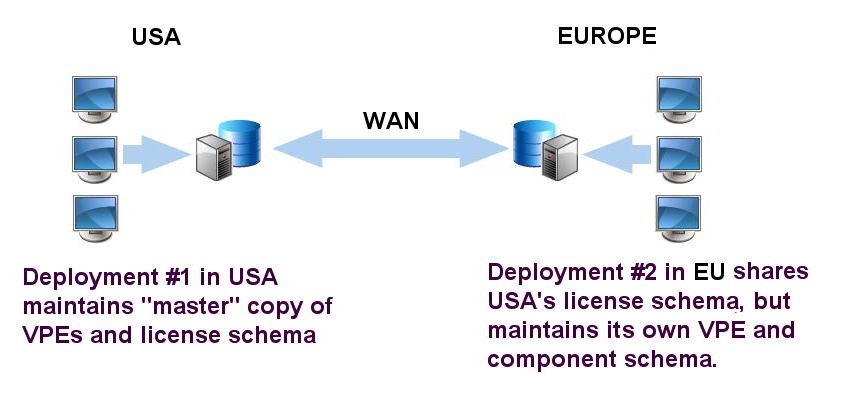
When a user in Europe logs in to aPriori, there's a brief user/password validation that takes place over the WAN to confirm the user's credentials as stored in the USA license schema, but thereafter all work occurs locally in deployment #2.
Without VPE Sync, VPE updates need to be manually installed in both geographic locations. Or if changes are made to the master copy of the VPEs in the USA, a VPE administrator needs to export the changed VPE, send it to Europe, and a VPE Administrator in Europe would need to import the VPE locally.
With VPE Synchronization, the USA installation can be designated as a VPE Sync source, and the Europe installation can define subscriptions to import VPEs from the USA site.
This basic configuration can be expanded in many ways: one or many sites can be subscribers to one or many source sites.
The basic requirements are:
- All deployments must share the same license schema (that is, the schema that is specified when the aPriori client is installed)
- Permissions must be correctly configured: the vpe.sync.admin.group must be defined at installation time (by default, it is set equal to the vpe_administrators group), and users creating or editing subscription jobs must have CREATE, READ, UPDATE, and DELETE permissions to the VPEs they want to sync on both the source and subscriber systems.