PCBA Costing
Introduction to PCBA
PCBAs are assemblies of electrical or electronic components used on a Printed Circuit Board (PCB). PCBAs are implemented in almost all areas of electronic equipment manufacture
PCBAs consist of mostly purchased components, with a variety of assembly and testing processes to complete the end product.
Tip:
See also the Introduction to PCBA aP Academy training course, and the PCBA section of the Cost Model Guide for more details
Note:
In industry, "PCB" and "PCBA" are often used as interchangeable terms, but for aPriori use these are two distinct entities.
The aPriori PCBA Module
The aPriori PCBA module allows you to analyze (cost) rigid Printed Circuit Board Assemblies (PCBAs).
Note:
See the PCBA installation guide and Configuring the Wire Harness and PCBA Process Groups for details of setting up the PCBA module in your system.
This addresses the major cost drivers for PCBAs production:
- The cost of the board itself (either derived using aPriori - see PCB Costing - or directly from the supplier).
- The cost of the individual components in the PCBA.
- The cost of assembling, testing, and other processes to manufacture the PCBA from those components.
Benefits of Using PCBA
- Provides faster, better estimates: It allows you to generate cost estimates with more consistency and with more detail in comparison to using alternative methods such as traditional spreadsheet calculators.
- Automates costing: The cost estimations are highly automated and can be used in conjunction with Silicon Expert to extract live costing of components.
- Enables collaboration: The tool allows for a high degree of collaboration bridging the gap between electronic design use case and their mechanical counterparts. Collaboration is enabled because the electronic component costs work within the same directory as the mechanical components, so you can fully realize, with accurate precision, the costing associated to a complete assembly.
PCBA Module Implementation
The PCBA module is implemented as a Digital Factory (see Wire Harness and PCBA Digital Factories), with two process groups:
- PCBA: for the Printed Circuit Board Assembly, putting all the mounted components onto the board. See Cost a PCBA.
- a “user guided” process group containing an aPriori-configured Component Library that provides cost information for all PCBA-related parts used by your company.
This separation gives you flexibility to design and cost either the board by itself, or the board plus all the components. For example, you may design and make your own board, but buy in all the electronics from third-party suppliers.
PCBA Routings
The PCBA Assembly Process Group routings (see Edit a Process Routing) are summarized in the following illustration.
Tip:
to display the full routing diagram in aP Pro, open the Manufacturing Process pane, then select Edit > Routing Selection and select that View > Show Uncosted Nodes within Visible Routings.
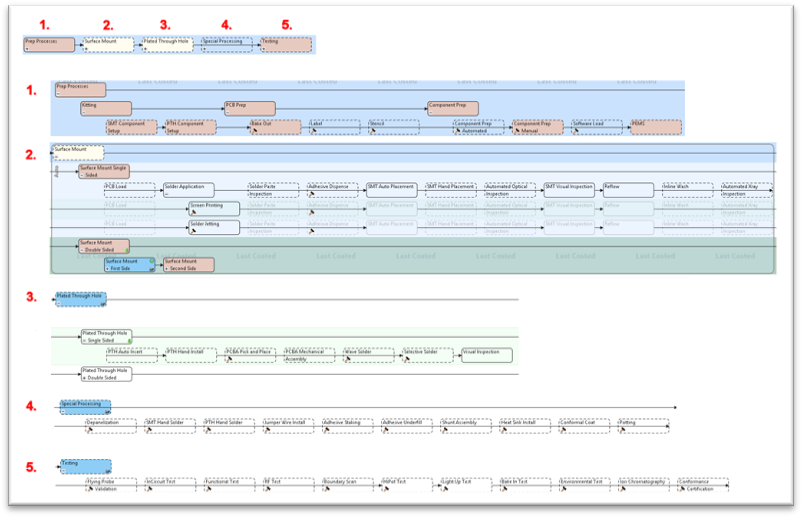
- Prep Processes – Surface Mount Technology (SMT) Component Setup, Plated Through Hole (PTH) Component Setup, Bake Out, Label, Stencil, Automated Component Prep Automated, Manual Component Prep, Component Software Load, PEMS/MSDS
- Surface Mount – (single and double sided) - PCB Load, PCB Flip, Screen Printing, Solder Jetting, Solder Paste Inspection, Adhesive Dispense, SMT Auto Placement, SMT Hand Placement, Automated Optical Inspection, SMT Visual Inspection, Reflow, Inline Wash, Automated Xray Inspection
- Plated Through Hole – PTH Auto Insert, PTH Hand Install, Wave Solder, Selective Solder, Visual Inspection
- Special Processing –Depanelization, SMT Hand Solder, PTH Hand Solder, Jumper Wire Install, Adhesive Stake, Adhesive Underfill, Shunt Assembly, Heat Sink Install, Batch Wash, Conformal Coat, Potting, Final Assy
- Testing – Flying Probe Validation, InCircuit Test, Software Load, Functional Test, RF Test, Boundary Scan (JTAG), HiPot Test, Light Up Test, Bake In/Burn In Test, Environmental Test, Ion Chromatography, Conformance Certification
PCBA Costing Workflow
See PCBA Costing Workflow for details of a typical workflow.