Casting - Investment
Geometry or Cost Engine Changes that Could Impact Configured Digital Factories
The following changes might impact costing, even for Digital Factories that use earlier cost model versions.
- NO IMPACT
Bug Fixes or Small Improvements to Prior Cost Model Versions
The following changes might impact costing for Digital Factories that use earlier cost model versions.
- NO IMPACT
Cost Model Changes that Do Not Affect Configured Digital Factories
The following changes do not affect costings with Digital Factories that use earlier cost model versions. The changes are available only in the latest cost model version.
- Band Saw Process (impacts cycle time): Previously, default gate cutoff time was 120, 300, or 900 seconds, based on times and part mass thresholds specified by cost model variables (see Deprecated Lookup Tables and Cost Model Variables). In this release, it is significantly shorter (10, 20, or 40 seconds per gate), particularly for smaller parts. The number of gates and the time per gate is looked up by mass in the lookup table partMassBasedData.
- Belt Sand Process (impacts cycle time): Previously, default grinding time was 300, 900, and 1800 seconds, based on times and part mass thresholds specified by cost model variables (see Deprecated Lookup Tables and Cost Model Variables). In this release, it is significantly shorter (30, 45, or 60 seconds per gate), particularly for smaller parts. The number of gates and the time per gate is looked up by mass in the new lookup table partMassBasedData.
- Abrasive Disc Grinding Operation of the Bench Operation Process (impacts cycle time): Previously, default grinding time was 300, 900, and 1800 seconds, based on times and part mass thresholds specified by cost model variables (see Deprecated Lookup Tables and Cost Model Variables). In this release, it is significantly shorter (30, 45, or 60 seconds per gate), particularly for smaller parts. The number of gates and the time per gate is looked up by mass in the new lookup table partMassBasedData.
- Abrasive Wheel Cutting Operation of the Bench Operation Process (impacts cycle time): Previously, default cutoff time was 120, 300, or 900 seconds, based on times and part mass thresholds specified by cost model variables (see Deprecated Lookup Tables and Cost Model Variables). In this release, it is significantly shorter (10, 20, or 40 seconds per gate), particularly for smaller parts. The number of gates and the time per gate is looked up by mass in the new lookup table partMassBasedData.
- Ceramic Core Finishing Operation of the Bench Operation Process (impacts cycle time): Previously, the dimensional inspection time for this operation was 300 seconds by default, as specified by a cost model variable (see Deprecated Lookup Tables and Cost Model Variables). In this release, the time is 60, 90 , or 240 seconds, as looked up by core mass in the new lookup table coreMassBasedData. Inspection times decrease compared to the previous release, particularly for smaller parts.
- Drying and Cooling Processes (no cost impact by default): This release provides the option to exclude the costs associated with Cooling and Drying. By default, these costs are included. Administrators can customize the default with the new cost model variable includeDryingAndCooling. Users can override the default with the new setup option Include Drying and Cooling Processes. Excluding these processes deceases fully burdened cost by around 40%.
-
Finishing Operation of the Bench Operation Process (impacts cycle time): Previously, finishing time (not including inspection time) was the result of applying the finishing rate to the total surface area of the part. In this release, it is the result of applying the finishing rate to a percentage of part surface area, as looked up by part mass in the new lookup table partMassBasedData. Finishing times decrease compared to the previous release, particularly for large parts.
Previously, default inspection time was 30 seconds regardless of part size (as specified by a now-deprecated cost model variable). In this release, it is looked up by part mass in the lookup table partMassBasedData. Inspection times decrease for small parts and increase for large parts, compared to the previous release.
-
Flash Fire De-Waxing Process (impacts cycle time): Previously, soak time ranged between around 3 and 7 hours, and was looked up by number of dip cycles in the lookup table tblFlashFireFurnaceSoakTime. In this release, it ranges from around 1/2 hour and 2 hours, and is looked up by number of dip cycles in the new lookup table dipCycleBasedData. Cycle times decrease, compared to the previous release.
- Knockout Process (impacts cycle time): Previously, default knockout time per tree was 0.33 hours (as specified by a now-deprecated cost model variable, regardless of number of dip cycles. In this release, it ranges from 0.08 to 0.99 hours, as looked up by number of dip cycles in the new lookup table dipCycleBasedData.
- Mold Burnout Process (no cost impact): Previously, soak time was looked up by number of dip cycles in the lookup table tblFlashFireFurnaceSoakTime. In this release, it is looked up by number of dip cycles in the new lookup table dipCycleBasedData.
- Mold Preheating Process (impacts cycle time): Previously, default preheat furnace soak time was 4 hours (as specified by a now-deprecated cost model variable), regardless of number of dip cycles. In this release, it ranges from 6 to 10 hours, and it is looked up by number of dip cycles in the new lookup table dipCycleBasedData. Cycle times increase, compared to the previous release.
- Tree Assembly Operation of the Bench Operation Process (impacts cycle time): Previously, the default time to attach a wax pattern to the tree was 300 seconds per gate (as specified by a now-deprecated cost model variable), regardless of part mass. In this release, time per gate is 5, 30, or 300 seconds, as looked up by part mass in the new lookup table partMassBasedData. For parts whose mass is less than or equal to 0.68 Kg, tree assembly times decrease significantly compared to the previous release.
-
Ceramic Core Firing Process (impacts cycle time): In previous releases, aPriori assumed a single layer of cores in the oven and assumed the number of cores was related to the core area compared to the oven floor area. In addition, aPriori had a hard coded lower limit that assumed a core would utilize at least 1% of the oven floor space.
In this release, aPriori calculates the number of cores that will fit in the oven with a basic 3-dimensional nesting algorithm. The cost model variable nestingAllowance_perimeter_ceramicCoreFireOven (25.4mm by default) controls how close a core can be placed to the edge of the oven. The cost model variables ceramicCoreOvenHorizontalSpacing (25.4mm by default) and ceramicCoreOvenVerticalSpacing (50.8mm by default) control the spacing of the cores in the horizontal and vertical directions.The spacing plus the core dimensions are used to calculate how many cores can fit in the oven. There no longer is a lower limit on the utilization of oven floor space.
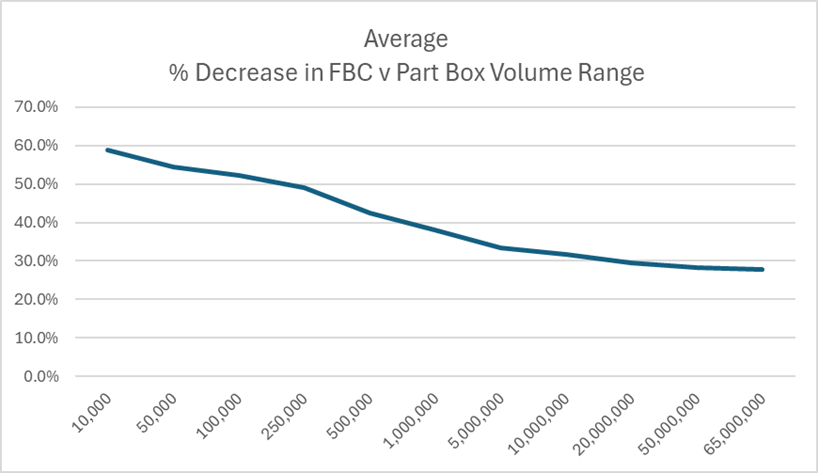
The result of the changes is a significant reduction in fully burdened cost, with an average reduction of 27% and a maximum reduction of 72% (for very small parts). The following graph shows how the size of the reduction varies by the part bounding box volume in mm3:
Note:
Fluorescent Penetrant Testing cycle time calculation has been updated in Other Secondary Processes, resulting in a reduced cycle time and cost. This process is included automatically in the Investment Casting routing.
Deprecated Lookup Tables and Cost Model Variables
Deprecated lookup tables:
- tblFlashFireFurnaceSoakTime
- tblMoldBurnoutSoakTime
Deprecated cost model variables:
- coredimensionalInspectionTime
- defaultCycleTime_knockOut
- defaultSoakTime_preheatFurnace