Assembly
Cost impact for upgrades to aPriori Professional 2021 R1 SP1
Geometry or Cost Engine Changes that Could Impact Configured Digital Factories
The following changes might impact costing, even for Digital Factories that use earlier cost model versions.
- NO IMPACT
Bug Fixes or Small Improvements to Prior Cost Model Versions
The following changes might impact costing for Digital Factories that use earlier cost model versions.
- NO IMPACT
Cost Model Changes that Do Not Affect Configured Digital Factories
The following changes do not affect costings with Digital Factories that use earlier cost model versions. The changes are available only in the latest cost model version.
- Welding Efficiency Factor (impacts Cycle Time): For the MIG and TIG welding processes, this release updates the calculation of the time for the arcing phase of welding. The calculation now includes a welding efficiency factor that accounts for the time required for activities such as fixturing and clamping, moving, waiting for cooling, inspecting, and straightening.
The factor is controlled by the cost model variable weldingEfficiencyFactor (0.45 in starting point Digital Factories), which specifies the fraction of the arcing phase which is actual arc time.
This change alone more than doubles the calculated time for the arcing phase (but note that this may be either increased or offset by other changes).
- Welding Travel Speed and Number of Passes (impacts Cycle Time): For the MIG and TIG welding processes, this release improves the determination of travel speed and number of welding passes for the linear rate method of calculating welding time. As a result, travel speeds and welding times may change compared to the previous release.
- Wire Diameter (impacts Cycle Time): For the MIG welding processes, this release improves the determination of wire diameter, which impacts arc time with the volumetric rate method and tack time with both the volumetric and linear rate methods of calculating welding time. In the previous release, wire diameter was specified by a machine property, and did not vary across welds. In this release, wire diameter is based on weld throat thickness, filler material, and gas type, by default. Users can override the default with a setup option. As a result, deposition rate and welding times may change compared to the previous release.
- Wire Feed Rate (impacts Cycle Time): For the MIG welding processes, this release improves the determination of wire feed rate, which impacts arc time for the volumetric rate method and tack time for both the volumetric and linear rate methods of calculating welding time. In the previous release, wire feed rate was specified by a machine property. In this release, wire feed rate is based on weld throat thickness, filler material, gas type, and wire diameter. As a result, deposition rate and welding times may change compared to the previous release.
- Tack Time (impacts Cycle Time): This release corrects some omissions in the calculation of tack time. For Manual MIG Welding and Manual TIG Welding, tack time now accounts for gun cleaning time. For Robotic MIG Welding and Robotic TIG Welding, tack time previously was neglected but now is included, and accounts for gun manipulation time and gun cleaning time as well as actual tacking time. Times and costs increase as a result of this change.
- Arc Efficiency (impacts Cycle Time): For the MIG and TIG welding processes, this release increases the default value of the cost model variable arcEfficiency, which represents the percentage of welding wire that is deposited and not lost to spatter or evaporation. The value increases from 50% to 86%, increasing deposition rate, which decreases arc time for the volumetric rate method and decreases tack time for both the linear and volumetric rate methods.
- Welding Gas Cost (impacts Additional Direct Costs): For the MIG welding processes, this release updates cost data for both argon and argon CO2 assist gasses. As a result of this change, estimated cost for argon CO2 gas decreased by around 38%, and estimated cost for argon gas increased by around 60%, for welds with leg length greater than about 0.5mm. In general, the size of the change depends on filler material (steel or aluminum) and weld size.
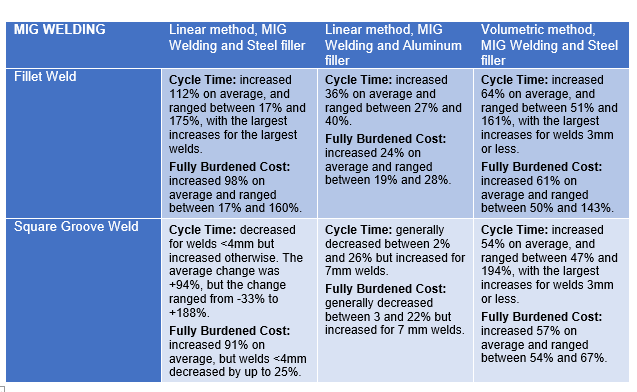
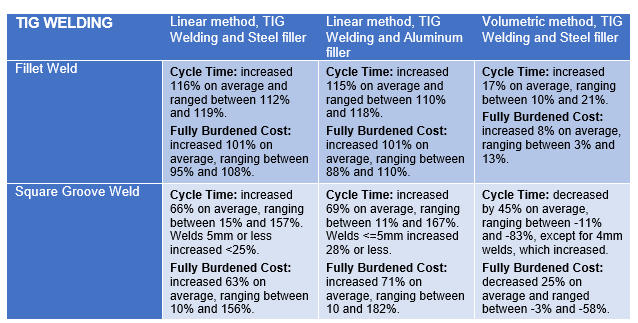
Due to the updates described in this section, welding times may change significantly compared to the previous release. The amount of change depends on the welding process (MIG or TIG), weld type, weld size, filler material, and estimation method (linear or volumetric). In a set of test parts, the following changes were observed for fillet welds and square groove welds: