Economic Updates
Exchange Rates
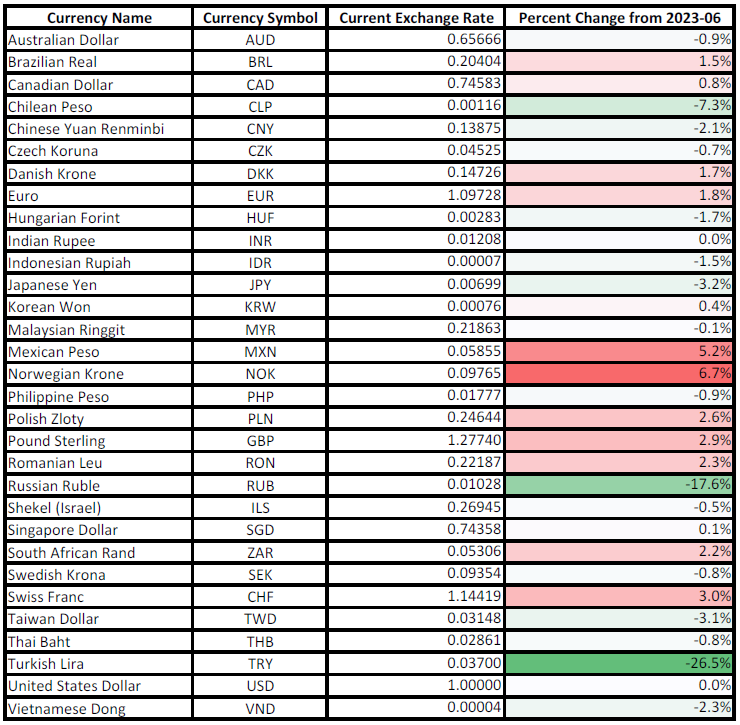
Since the Regional Data Libraries 2023-06 release, most currencies have remained relatively constant, however there are a few noteworthy changes:
- The US dollar index has held high over the past few months supported by rising US Treasury yields and confidence that the Federal Reserve will keep monetary policy restrictive for the near term.
- Western sanctions have had a broad impact on Russia’s exports abroad which continue to drop as indicated by falling revenue from oil and natural gas. This combined with increased imports has had a negative impact on the ruble’s exchange rate.
- Turkey’s central bank has significantly increased the country's benchmark interest rate resulting in a further drop of the lira.
This chart shows the changes and percent changes in currency exchange rates relative to the 2023-06 Regional Data Libraries release:
Labor Rates
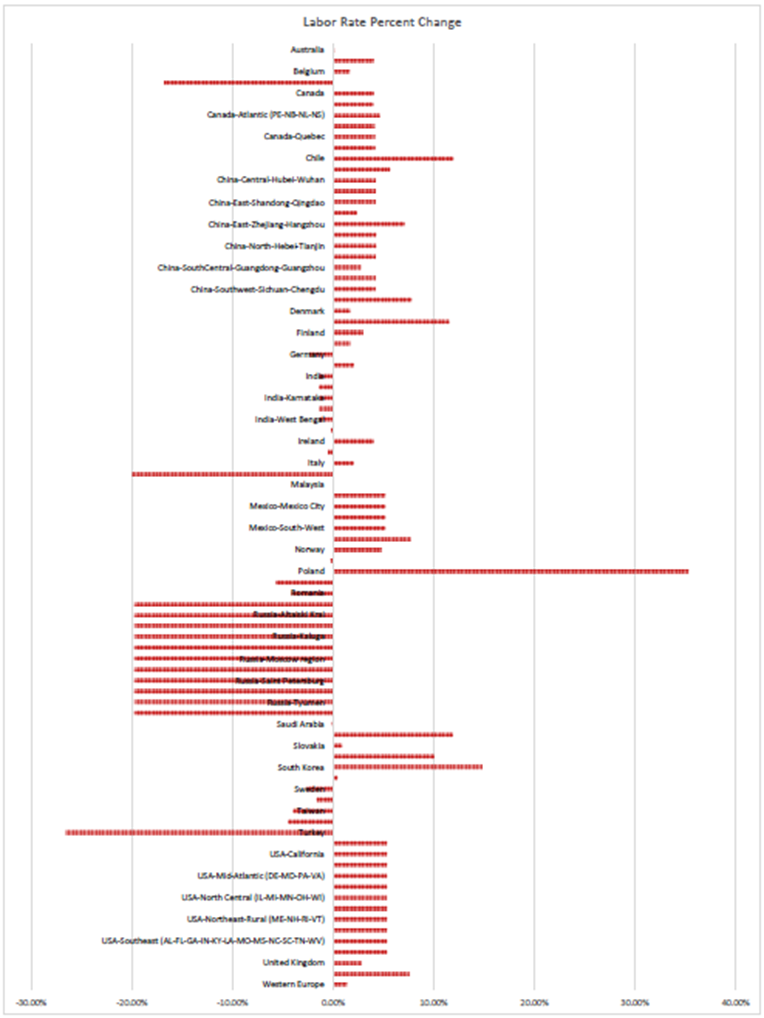
While many labor rates have remained relatively static since the 2023-06 release, there have been a number of changes that are considerable:
- Brazi’s drop in unemployment figures during the previous quarter has had a negative impact on their labor rate.
- Chile’s recent increase in the national minimum wage has directly caused an increase in the national labor rate.
- An increase in wages and salaries had a direct influence on Eastern European labor rates.
- Persistent inflation has driven a decline in Japan’s labor rate for more than a year.
- An increase in employment rate in Poland has influenced an increase in their labor rate.
- In Russia, with the currency devaluation and continuing inflation due the disciplinary actions resulting from their conflict with Ukraine, there continues to be a negative effect on labor rates, which are declining in terms of the US dollar.
- Although growth and demand for labor has been slowing overall in Singapore, they are still responsible for an increase in labor rate.
- An increase in South Korea’s minimum wage has directly resulted in an increase in their labor rate.
- An increase in the unemployment rate in Turkey has resulted in a decrease in labor rate.
This chart shows Labor Rate changes relative to the 2023-06 Regional Data Libraries release:
Total Manufacturing Rates
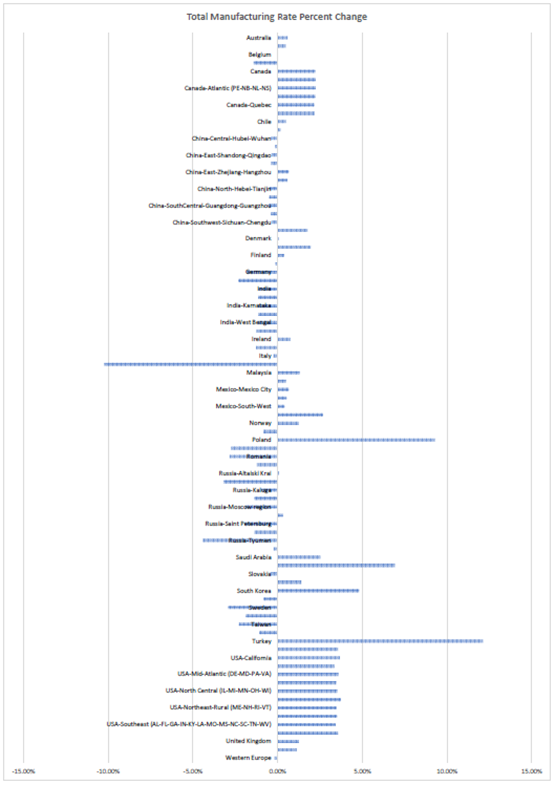
Most total manufacturing rates (labor + direct and indirect overhead) have remained steady since the Regional Data Libraries 2023-06 release, however some regional rates experienced a greater change:
- Japan’s factory output decreased at a fast pace during recent months, attributable to a drop in overseas demand for key industries like automotive and semiconductors.
- Poland’s continued advances in its manufacturing capability and capacity coupled with increased demand due to the ongoing war in Ukraine resulted in an increase in its manufacturing rate.
- Ongoing recovery from a major earthquake last February plus increased demand has resulted in an increase in Turkey’s manufacturing rate.
This chart shows changes in total manufacturing rates relative to the 2023-06 Regional Data Libraries release:
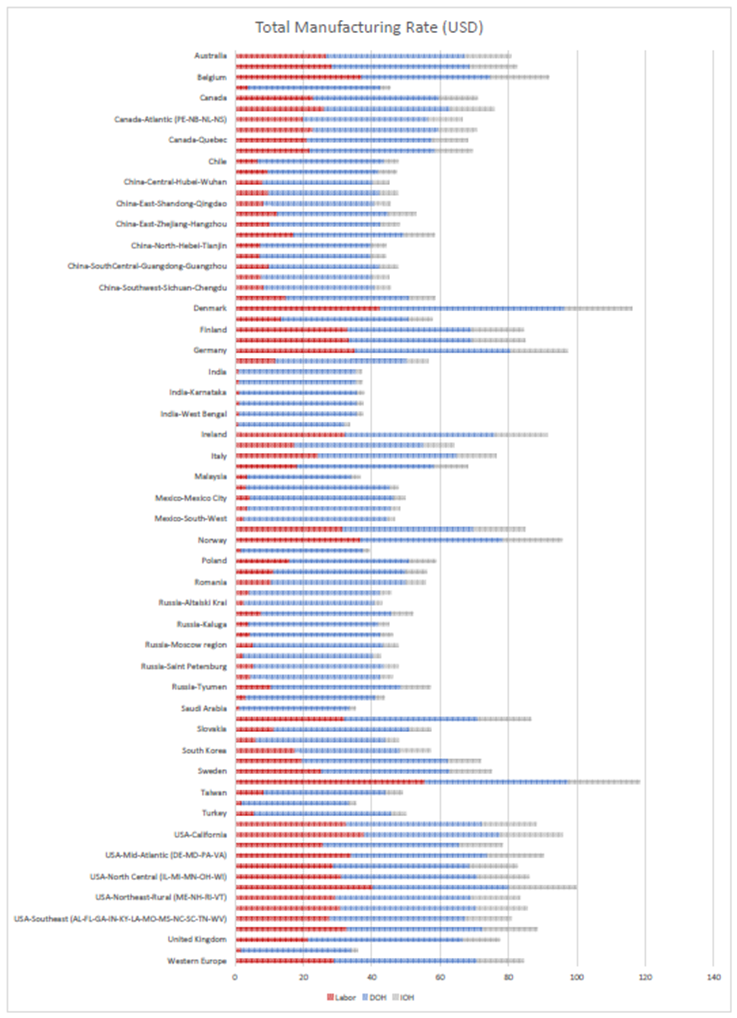
This chart represents the average total manufacturing rate for each region in the Regional Data Libraries 2023-09 release.
Material Rates
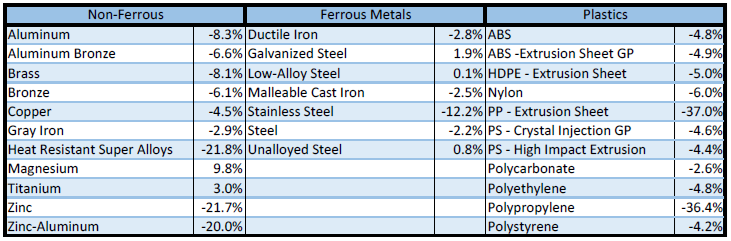
Material prices were generally stable since the Regional Data Libraries 2023-06 release, with a few notable exceptions:
- Consumption rates for heat-resistant super alloys (HSRAs) have diminished in industries like aerospace and oil and gas that were heavily impacted by the pandemic, resulting in a decrease in prices for HRSAs.
- A supply rebound in the aftermath of a languishing production bottleneck in 2022 has resulted in a price decrease for zinc and zinc-aluminum.
- Flat demand growth has resulted in dropping stainless steel prices.
- Polypropylene prices have been negatively affected by decreasing demand coupled with an oversupply of product.
These are the material rate changes relative to the 2023-06 release: