Stock Machining
Geometry or Cost Engine Changes that Could Impact Configured Digital Factories
The following changes might impact costing, even for Digital Factories that use earlier cost model versions.
-
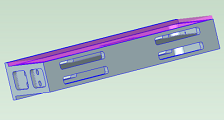
Shelf-like Volumes: In previous releases, shelf-like volumes with two or three open sides were included in the BulkRemoval GCD. In this release, many such volumes with planar floors and perpendicular walls are recognized as Pocket GCDs.
The image below shows a shelf-like pocket in purple:
-
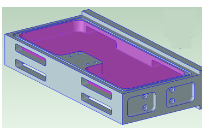
Volumes with Undercut Walls: In previous releases, pocket-like volumes with undercuts through the walls were included in the BulkRemoval GCD. In this release, such volumes are extracted as Pocket GCDs, provided the walls form a closed loop and are perpendicular to the floor (see the image below).
-
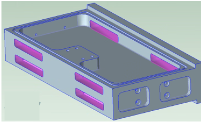
Through Pockets: In previous releases, the wall of a through pocket could not be contiguous and coplanar with the floor of another volumetric feature. Such through volumes were previously included in the BulkRemoval GCD. In this release, such volumes are among those extracted as through Pockets (see the image below).
-
StockTrim GCDs (impacts cycle times for roughing operations): StockTrim GCDs represent material allowances added to the finished part's dimensions in order to determine the dimensions of the raw stock from which the part is machined. In previous releases, aPriori extracted a single StockTrim GCD for each part. Material-removal calculations for the StockTrim GCD used the Bulk Milling algorithm (which uses a single, volumetric-removal rate regardless of feature sizes and orientations).
In this release, with Rectangular Bar, Square Bar, Plate, and Hex stock, aPriori extracts multiple StockTrim GCDs for most parts (6 for box-shaped stock and 1, 2 or 3 for Hex stock). Material removal calculations now use a Rough Milling operation that takes into account the approach direction as well as the appropriate tool size and cut depth for each StockTrim.
As a result of these changes, cycle times for roughing operations may change.
Note:
If you are using a previous cost model version, your cost model logic is not compatible with the new extraction behavior. Set the site variable enableMultipleStockTrims to false to restore the old extraction behavior, which is compatible with the old cost model logic.
Note:
If you are using the new cost model version, your cost model logic requires the new extraction behavior. Ensure that the site variable enableMultipleStockTrims is set to true (the default in starting point Digital Factories).
Note:
If you are using the new cost model version, you must re-extract GCDs for any old scenarios. A StockTrim GCD extracted in a previous release will fail to cost with the new cost model, and aPriori will display a message advising you to re-extract GCDs.
-
Dovetail Slot Recognition: This release improves recognition of dovetail Slots. As a result, in rare cases, some features previously not recognized as Slots will now have a corresponding Slot GCD.
Bug Fixes or Small Improvements to Prior Cost Model Versions
The following changes might impact costing for Digital Factories that use earlier cost model versions.
- NO IMPACT
See also the Machining process group.
Cost Model Changes that don't Affect Configured Digital Factories
The following changes do not affect costings with Digital Factories that use earlier cost model versions. The changes are available only in the latest cost model version.
-
Stock Trim Roughing (impacts cycle time): This release improves cycle time estimates for Stock Trim roughing operations.
In previous releases, aPriori extracted a single StockTrim GCD for each part. Material-removal calculations for the StockTrim GCD used the Bulk Milling algorithm (which uses a single, volumetric-removal rate regardless of feature sizes and orientations).
In this release, with Rectangular Bar, Square Bar, Plate, and Hex stock, aPriori extracts multiple StockTrim GCDs for most parts. Material removal calculations now use a Rough Milling operation that takes into account the approach direction as well as the appropriate tool size and cut depth for each StockTrim.
Note:
The new cost model version requires the new geometry extraction behavior. Ensure that the site variable enableMultipleStockTrims is set to true (the default).
Note:
If you are using the new cost model version, you must re-extract GCDs for any old scenarios. A StockTrim GCD extracted in a previous release will fail to cost with the new cost model, and aPriori will display a message advising you to re-extract GCDs.
-
Roughing Cut Depth (impacts cycle time): This release improves cycle time estimates for rough milling of Pockets, Slots, Stock Trims, large Holes, and part Perimeters.
In the previous release, the calculation of the volumetric removal rate for rough milling operations sometimes assumed a cut depth that was too large. The default cut depth was based on tool cutting data and was bounded above by the total depth of material to be removed, but it did not take into account the number of required passes and the resulting depth for each pass. As a result, the cost model sometimes overestimated cut depth and removal rate for the last pass, and so underestimated cycle time.
This release improves estimates by determining the number of axial passes required for the axial depth of material to be removed (given the tool data). The default axial cut depth is then assumed to be the same for each pass: the axial depth of material divided by the number of axial passes.
For Stock Trim roughing, the cost model also now determines the number of radial passes required for the radial depth of material to be removed. The default radial cut depth is assumed to be the same for each pass: the radial depth of material divided by the number of radial passes. For Slot roughing, the radial cut depth is now sometimes adjusted based on the roughing tool's length-to-diameter ratio.
The result is improved estimates of material removal rate and cycle time.
Note:
For a given roughing operation, you can revert to the cut-depth behavior of the previous release by setting the setup options Axial Cut Depth and Radial Cut Depth to Cutting Data Derived Axial Cut Depth. You can revert to the cut-depth behavior of the previous release for all the current part's roughing operations by setting the setup option Axial Tool Path Override to true. You can revert to the cut-depth behavior of the previous release for all parts' roughing operations by setting the cost model variable defaultAxialToolPathOverride to true.
-
Tool Diameter for Pocket Rough Milling (impacts cycle time): This release improves estimates of chipmaking time for Pocket roughing by improving tool diameter selection.
In the previous release, aPriori sometimes selected Pocket roughing tools that were too large. By default, tool diameter was 85% of the Pocket's inside diameter, regardless of the Pocket's shape.
In this release, for rectangular Pockets, tool diameter is 85% of inside diameter only if the Pocket is long and thin (that is, its aspect ratio differs sufficiently from 1). For rectangular Pockets that are not long and thin, the closer they are to square, the smaller is the selected tool diameter (as a percentage of the Pocket's inside diameter).
-
Tool Type for Pocket Rough Milling (impacts cycle time): This release improves tool type selection for Pocket roughing.
In the previous release, by default, the cost model assumed the use of a ball end mill for pockets that have a curved floor, undercut walls, or matching wall and bottom fillet diameters.
In this release, by default, the cost model assumes the use of a ball end mill only for pockets whose walls are undercut by more than 20 degrees. You can customize this threshold with the cost model variable filletAngleForBallEndMill.
-
Rough Milling Cutting Efficiency (impacts cycle time): This release improves estimates of roughing non-chipmaking time for Pocket, Slot, and hole GCDs.
In the previous release, non-chipmaking time was based on an estimate of cutting efficiency--the fraction of total tool engagement time during which the tool is "cutting air" when running off the edge of the feature in order to clear swarf away from the cutting surface. Cutting efficiency was a static value (0.67) that did not depend on feature geometry.
In this release, non-chipmaking time for rough milling of Pocket, Slot, and hole GCDs takes into account the length of the feature openings (edges with no wall). The cost model now assumes that half the tool diameter runs off the edge each time the tool gets to an opening. A volume that is completely enclosed by walls has no non-chipmaking time.
As a result of these enhancements, rough milling cycle time estimates may change compared to the previous release. Whether the cycle time estimate increases or decreases for a given part depends on its specific features and characteristics. In a set of diverse test parts, cycle time estimates increased for 59% of the test parts and decreased for 41%.
- Cycle Time Reductions: Cycle time reductions of more than 20% tended to occur in parts that previously had a large number of rough milling operations that used ball end mills. In this release, these rough milling operations usually now use flat-bottom end mills which have faster material removal rates (see Tool Type for Pocket Rough Milling, above). These parts also sometimes had a significant number of enclosed pockets, for which machining efficiency has increased (see Rough Milling Cutting Efficiency, above).
- Cycle Time Increases: Large increases in cycle time typically were due to recognition of more Pocket GCDs, and recognition of individual Stock Trim GCDs, particularly for larger parts which use larger roughing tools. The improved estimation of axial cut depth resulted in more accurate but decreased estimated material removal rates, resulting in higher cycle times. See Geometry or Cost Engine Changes that Could Impact Configured Digital Factories, Stock Trim Roughing (above), and Roughing Cut Depth (above).